• Skip to main content
  • Skip to header right navigation
  • Skip to site footer

Log in
www.sages.org

SAGES

Reimagining surgical care for a healthier world

  • Home
    • SAGES Home
    • SAGES Foundation Home
  • About
    • Awards
    • Who Is SAGES?
    • Leadership
    • Our Mission
    • Advocacy
    • Committees
      • SAGES Board of Governors
      • Officers and Representatives of the Society
      • Committee Chairs and Co-Chairs
      • Committee Rosters
      • SAGES Past Presidents
    • Why Should You Support SAGES?
    • SAGES Swag
  • Meetings
    • SAGES NBT Innovation Weekend
    • SAGES Annual Meeting
      • 2026 Annual Meeting
      • 2027 Scientific Session Call for Abstracts
      • 2027 Emerging Technology Call for Abstracts
    • CME Claim Form
    • SAGES Past, Present, Future, and Related Meeting Information
    • SAGES Related Meetings & Events Calendar
  • Join SAGES!
    • Membership Application
    • Membership Benefits
    • Membership Types
      • Requirements and Applications for Active Membership in SAGES
      • Requirements and Applications for Affiliate Membership in SAGES
      • Requirements and Applications for Associate Active Membership in SAGES
      • Requirements and Applications for Candidate Membership in SAGES
      • Requirements and Applications for International Membership in SAGES
      • Requirements for Medical Student Membership
    • Member Spotlight
    • Give the Gift of SAGES Membership
  • Patients
    • Join the SAGES Patient Partner Network (PPN)
    • Patient Information Brochures
    • Healthy Sooner – Patient Information for Minimally Invasive Surgery
    • Choosing Wisely – An Initiative of the ABIM Foundation
    • All in the Recovery: Colorectal Cancer Alliance
    • Find A SAGES Surgeon
  • Publications
    • Clinical / Practice / Training Guidelines, Statements, and Standards of Practice
    • Sustainability in Surgical Practice
    • SAGES Stories Podcast
    • SAGES Lead Up Podcast
    • Patient Information Brochures
    • Patient Information From SAGES
    • TAVAC – Technology and Value Assessments
    • Surgical Endoscopy and Other Journal Information
    • Innovative Surgical Trends
    • SAGES Manuals
    • MesSAGES – The SAGES Newsletter
    • COVID-19 Archive
    • Troubleshooting Guides
  • Education
    • Wellness Resources – You Are Not Alone
    • Avoid Opiates After Surgery
    • SAGES Subscription Catalog
    • SAGES TV: Home of SAGES Surgical Videos
    • The SAGES Safe Cholecystectomy Program
    • Masters Program
    • Resident and Fellow Opportunities
      • MIS Fellows Course
      • SAGES Robotics Residents and Fellows Courses
      • SAGES Free Resident Webinar Series
      • Advanced Laparoscopy and Fluorescence-Guided Surgery Course for Fellows
      • Fellows’ Career Development Course
    • SAGES S.M.A.R.T. Enhanced Recovery Program
    • SAGES @ Cine-Med Products
      • SAGES Top 21 Minimally Invasive Procedures Every Practicing Surgeon Should Know
      • SAGES Pearls Step-by-Step
      • SAGES Flexible Endoscopy 101
    • SAGES OR SAFETY Video Activity
    • Foregut Video Atlas
  • Opportunities
    • Join the SAGES Patient Partner Network (PPN)
    • Fellowship Recognition Opportunities
    • SAGES Advanced Flexible Endoscopy Area of Concentrated Training (ACT) SEAL
    • Multi-Society Foregut Fellowship Certification
    • Research Opportunities
    • FLS
    • FES
    • FUSE
    • Jobs Board
    • SAGES Go Global: Global Affairs
  • Learning Hub
You are here: Home / Abstracts / Transanal Endoscopic Video-Assisted (teva) Excision

Transanal Endoscopic Video-Assisted (teva) Excision

Madhu Ragupathi, MD, Dominique Vande Maele, MD, Javier Nieto, MD, T. Bartley Pickron, MD, Eric M Haas, MD FACS FASCRS. 1. Colorectal Surgical Associates, Ltd LLP, Houston, TX; 2. Division of Elective General Surgery, Department of Surgery, The University of Texas Medical School at Houston, TX


Introduction: Transanal endoscopic video-assisted (TEVA) excision represents an alternative approach for the surgical treatment of middle and upper rectal lesions not amenable to colonoscopic removal. By utilizing principles of single-incision laparoscopic surgery, TEVA excision optimizes access for safe and complete removal of these lesions without the need for a formal rectal resection. We describe our technique for TEVA excision and our early outcomes with this novel minimally invasive surgical approach.

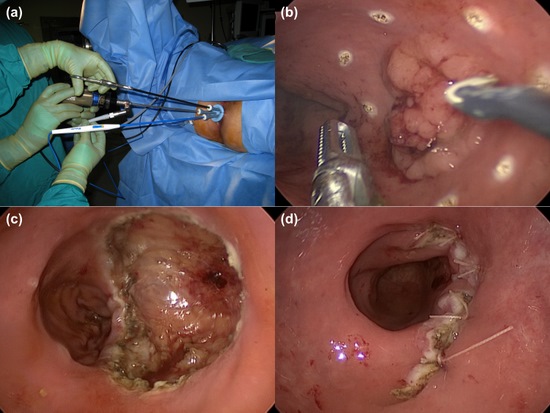
Methods and Procedures: Between March 2010 and September 2011, TEVA excision was performed for patients presenting for management of benign and malignant rectal lesions not amenable to colonoscopic or standard transanal removal. Patients were selected for TEVA excision if the proximal extent of the lesion extended beyond 8 cm from the anal verge. Early-stage adenocarcinomas (ultrasound stage: uT1N0) were also considered for TEVA excision. Demographic, intraoperative and postoperative data were assessed. A SILS™ port (Covidien, Mansfield, MA, USA) was placed in the anal canal for access in all cases (Fig. 1a). The port contains three cannulae for introduction of instrumentation into the rectal lumen and a supplementary cannula that facilitates carbon dioxide insufflation for creation of pneumorectum. Standard laparoscopic instruments were utilized for visualization, demarcation or scoring (Fig. 1b), and full-thickness transanal excision of the rectal lesion (Fig. 1c). The resulting wall defect was primarily closed with interrupted intra-luminal sutures (Fig. 1d).

Results: Twenty patients (50% male) with a mean age of 64.6±10.9 years (range: 40-86 years), mean BMI of 28.4±4.9 kg/m2 (range: 20.2-39.0 kg/m2), and median ASA of 2 (range: 1-3) underwent TEVA excision. Fourteen patients (70%) presented with benign disease (adenomas) and six patients (30%) presented with malignant disease (adenocarcinomas or carcinoids). The mean size of the lesions was 3.0±1.4 cm (range: 1.3-5.5 cm) and the mean distance from the anal verge was 10.6±2.4 cm (range: 6-15 cm). All TEVA excisions were successfully completed with a mean operative time of 80.1±21.0 min (range: 45-112 min). There were no intraoperative complications or conversions to another surgical approach. The mean length of hospital stay was 1.1±0.7 days (range: 0-3 days). One postoperative complication (5%) was encountered; a patient developed a rectovaginal fistula that spontaneously resolved without further intervention. Two patients (10%) underwent repeat interval TEVA excision, one for close surgical margins (within 1 mm) in a malignant case and another for recurrence of a villous adenoma 7 months after the initial procedure. One patient underwent a formal oncologic low anterior resection after TEVA excision revealed a T2 lesion.

Conclusions: Transanal endoscopic video-assisted excision is a safe and feasible approach for local excision of benign and superficial malignant rectal lesions. The approach facilitates exposure and access to pathologies of the middle and upper rectum and averts the need for formal rectal resection. Continued investigation and development of this novel and innovative modality will be important in establishing its role in minimally invasive colorectal surgery.


Session Number: PDIST – Posters of Distinction
Program Number: P003
View Poster

Related


Hours & Info

15821 Ventura Blvd Ste 400
Encino, CA 91436

1-310-437-0544

[email protected]

Monday – Friday
8am to 5pm Pacific Time

Find Us Around the Web!

  • Bluesky
  • X
  • Instagram
  • Facebook
  • YouTube

Copyright © 2026 · SAGES · All Rights Reserved

Important Links

Healthy Sooner: Patient Information

SAGES Guidelines, Statements, & Standards of Practice

SAGES Manuals

Refine Search