• Skip to main content
  • Skip to header right navigation
  • Skip to site footer

Log in
www.sages.org

SAGES

Reimagining surgical care for a healthier world

  • Home
    • SAGES Home
    • SAGES Foundation Home
  • About
    • Awards
    • Who Is SAGES?
    • Leadership
    • Our Mission
    • Advocacy
    • Committees
      • SAGES Board of Governors
      • Officers and Representatives of the Society
      • Committee Chairs and Co-Chairs
      • Committee Rosters
      • SAGES Past Presidents
    • Why Should You Support SAGES?
    • SAGES Swag
  • Meetings
    • SAGES NBT Innovation Weekend
    • SAGES Annual Meeting
      • 2026 Annual Meeting
      • 2027 Scientific Session Call for Abstracts
      • 2027 Emerging Technology Call for Abstracts
    • CME Claim Form
    • SAGES Past, Present, Future, and Related Meeting Information
    • SAGES Related Meetings & Events Calendar
  • Join SAGES!
    • Membership Application
    • Membership Benefits
    • Membership Types
      • Requirements and Applications for Active Membership in SAGES
      • Requirements and Applications for Affiliate Membership in SAGES
      • Requirements and Applications for Associate Active Membership in SAGES
      • Requirements and Applications for Candidate Membership in SAGES
      • Requirements and Applications for International Membership in SAGES
      • Requirements for Medical Student Membership
    • Member Spotlight
    • Give the Gift of SAGES Membership
  • Patients
    • Join the SAGES Patient Partner Network (PPN)
    • Patient Information Brochures
    • Healthy Sooner – Patient Information for Minimally Invasive Surgery
    • Choosing Wisely – An Initiative of the ABIM Foundation
    • All in the Recovery: Colorectal Cancer Alliance
    • Find A SAGES Surgeon
  • Publications
    • Clinical / Practice / Training Guidelines, Statements, and Standards of Practice
    • Sustainability in Surgical Practice
    • SAGES Stories Podcast
    • SAGES Lead Up Podcast
    • Patient Information Brochures
    • Patient Information From SAGES
    • TAVAC – Technology and Value Assessments
    • Surgical Endoscopy and Other Journal Information
    • Innovative Surgical Trends
    • SAGES Manuals
    • MesSAGES – The SAGES Newsletter
    • COVID-19 Archive
    • Troubleshooting Guides
  • Education
    • Wellness Resources – You Are Not Alone
    • Avoid Opiates After Surgery
    • SAGES Subscription Catalog
    • SAGES TV: Home of SAGES Surgical Videos
    • The SAGES Safe Cholecystectomy Program
    • Masters Program
    • Resident and Fellow Opportunities
      • MIS Fellows Course
      • SAGES Robotics Residents and Fellows Courses
      • SAGES Free Resident Webinar Series
      • Advanced Laparoscopy and Fluorescence-Guided Surgery Course for Fellows
      • Fellows’ Career Development Course
    • SAGES S.M.A.R.T. Enhanced Recovery Program
    • SAGES @ Cine-Med Products
      • SAGES Top 21 Minimally Invasive Procedures Every Practicing Surgeon Should Know
      • SAGES Pearls Step-by-Step
      • SAGES Flexible Endoscopy 101
    • SAGES OR SAFETY Video Activity
    • Foregut Video Atlas
  • Opportunities
    • Join the SAGES Patient Partner Network (PPN)
    • Fellowship Recognition Opportunities
    • SAGES Advanced Flexible Endoscopy Area of Concentrated Training (ACT) SEAL
    • Multi-Society Foregut Fellowship Certification
    • Research Opportunities
    • FLS
    • FES
    • FUSE
    • Jobs Board
    • SAGES Go Global: Global Affairs
  • Learning Hub
You are here: Home / Abstracts / T2DM & SG: Diabetes duration as prognostic factor of cure

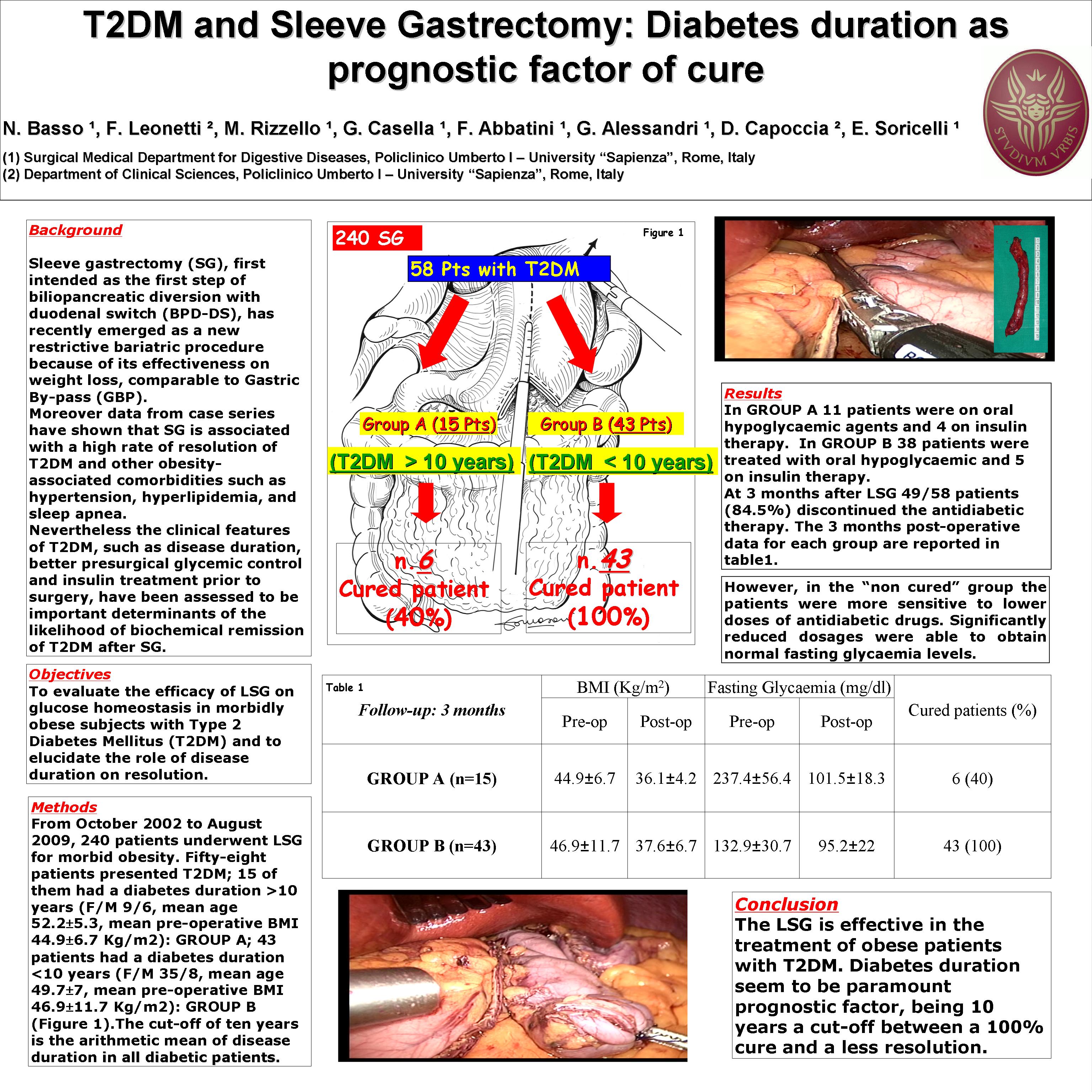
T2DM & SG: Diabetes duration as prognostic factor of cure

Objective of the study: To evaluate the efficacy of LSG on glucose homeostasis in morbidly obese subjects with Type 2 Diabetes Mellitus (T2DM) and to elucidate the role of disease duration on resolution.

Methods: From October 2002 to August 2009, 240 patients underwent LSG for morbid obesity. Fifty-eight patients presented T2DM: 15 of them had a diabetes duration >10 years (F/M 9/6, mean age 52.2±5.3, mean pre-operative BMI 44.9±6.7 Kg/m2): GROUP A; 43 patients had a diabetes duration <10 years (F/M 35/8, mean age 49.7±7, mean pre-operative BMI 46.9±11.7 Kg/m2): GROUP B.

Results: In GROUP A 11 patients were on oral hypoglycaemic agents and 4 on insulin therapy. In GROUP B 38 patients were treated with oral hypoglycaemic and 5 on insulin therapy.
At 3 months after LSG 49/58 patients (84.5%) discontinued the antidiabetic therapy. The 3 months post-operative data for each group are reported in table:

Follow-up: 3 months BMI (Kg/m2) Fasting Glycaemia (mg/dl) Cured patients (%)
Pre-op Post-op Pre-op Post-op
GROUP A (n=15) 44.9±6.7 36.1±4.2 237.4±56.4 101.5±18.3 6 (40)
GROUP B (n=43) 46.9±11.7 37.6±6.7 132.9±30.7 95.2±22 43 (100)

However, in the “non cured” group the patients were more sensitive to lower doses of antidiabetic drugs. Significantly reduced dosages were able to obtain normal fasting glycaemia levels.

Conclusions: The LSG is effective in the treatment of obese patients with T2DM. Diabetes duration seem to be paramount prognostic factor, being 10 years a cut-off between a 100% cure and a less percentage of resolution.


Session: Poster

Program Number: P061
View Poster

Related


Hours & Info

15821 Ventura Blvd Ste 400
Encino, CA 91436

1-310-437-0544

[email protected]

Monday – Friday
8am to 5pm Pacific Time

Find Us Around the Web!

  • Bluesky
  • X
  • Instagram
  • Facebook
  • YouTube

Copyright © 2026 · SAGES · All Rights Reserved

Important Links

Healthy Sooner: Patient Information

SAGES Guidelines, Statements, & Standards of Practice

SAGES Manuals

Refine Search