• Skip to main content
  • Skip to header right navigation
  • Skip to site footer

Log in
www.sages.org

SAGES

Reimagining surgical care for a healthier world

  • Home
    • SAGES Home
    • SAGES Foundation Home
  • About
    • Awards
    • Who Is SAGES?
    • Leadership
    • Our Mission
    • Advocacy
    • Committees
      • SAGES Board of Governors
      • Officers and Representatives of the Society
      • Committee Chairs and Co-Chairs
      • Committee Rosters
      • SAGES Past Presidents
    • Why Should You Support SAGES?
    • SAGES Swag
  • Meetings
    • SAGES NBT Innovation Weekend
    • SAGES Annual Meeting
      • 2026 Annual Meeting
      • 2027 Scientific Session Call for Abstracts
      • 2027 Emerging Technology Call for Abstracts
    • CME Claim Form
    • SAGES Past, Present, Future, and Related Meeting Information
    • SAGES Related Meetings & Events Calendar
  • Join SAGES!
    • Membership Application
    • Membership Benefits
    • Membership Types
      • Requirements and Applications for Active Membership in SAGES
      • Requirements and Applications for Affiliate Membership in SAGES
      • Requirements and Applications for Associate Active Membership in SAGES
      • Requirements and Applications for Candidate Membership in SAGES
      • Requirements and Applications for International Membership in SAGES
      • Requirements for Medical Student Membership
    • Member Spotlight
    • Give the Gift of SAGES Membership
  • Patients
    • Join the SAGES Patient Partner Network (PPN)
    • Patient Information Brochures
    • Healthy Sooner – Patient Information for Minimally Invasive Surgery
    • Choosing Wisely – An Initiative of the ABIM Foundation
    • All in the Recovery: Colorectal Cancer Alliance
    • Find A SAGES Surgeon
  • Publications
    • Clinical / Practice / Training Guidelines, Statements, and Standards of Practice
    • Sustainability in Surgical Practice
    • SAGES Stories Podcast
    • SAGES Lead Up Podcast
    • Patient Information Brochures
    • Patient Information From SAGES
    • TAVAC – Technology and Value Assessments
    • Surgical Endoscopy and Other Journal Information
    • Innovative Surgical Trends
    • SAGES Manuals
    • MesSAGES – The SAGES Newsletter
    • COVID-19 Archive
    • Troubleshooting Guides
  • Education
    • Wellness Resources – You Are Not Alone
    • Avoid Opiates After Surgery
    • SAGES Subscription Catalog
    • SAGES TV: Home of SAGES Surgical Videos
    • The SAGES Safe Cholecystectomy Program
    • Masters Program
    • Resident and Fellow Opportunities
      • MIS Fellows Course
      • SAGES Robotics Residents and Fellows Courses
      • SAGES Free Resident Webinar Series
      • Advanced Laparoscopy and Fluorescence-Guided Surgery Course for Fellows
      • Fellows’ Career Development Course
    • SAGES S.M.A.R.T. Enhanced Recovery Program
    • SAGES @ Cine-Med Products
      • SAGES Top 21 Minimally Invasive Procedures Every Practicing Surgeon Should Know
      • SAGES Pearls Step-by-Step
      • SAGES Flexible Endoscopy 101
    • SAGES OR SAFETY Video Activity
    • Foregut Video Atlas
  • Opportunities
    • Join the SAGES Patient Partner Network (PPN)
    • Fellowship Recognition Opportunities
    • SAGES Advanced Flexible Endoscopy Area of Concentrated Training (ACT) SEAL
    • Multi-Society Foregut Fellowship Certification
    • Research Opportunities
    • FLS
    • FES
    • FUSE
    • Jobs Board
    • SAGES Go Global: Global Affairs
  • Learning Hub
You are here: Home / Abstracts / Clinical & functional results of transanal endoscopic local excision of rectal tumors

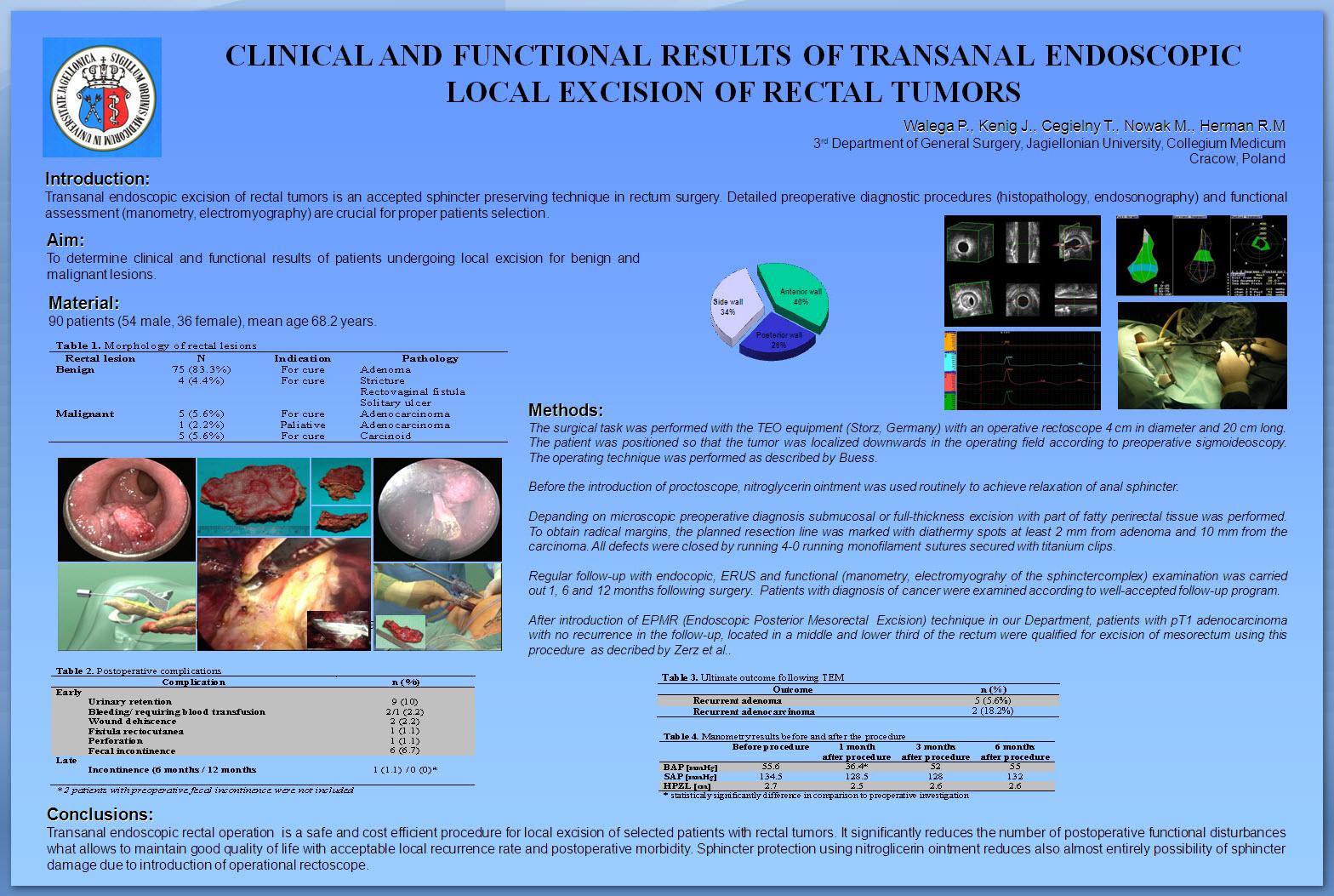
Clinical & functional results of transanal endoscopic local excision of rectal tumors

Transanal endoscopic excision of rectal tumors is an accepted sphincter preserving technique in rectum surgery. Detailed preoperative diagnostic procedures (histopathology, endosonography) and functional assessment (manometry, electromyography) are crucial for proper patients selection. Aim: To determine clinical and functional results of patients undergoing local excision for benign and malign lesions. Material and Methods: 90 patients (54 male, 46 female, mean age 68.4) treated for rectal tumor with transanal endoscopic rectal microsurgery technique at Department of Surgery. To avoid postoperative sphincter dysfunction NO ointment was routinely applied. Results: 75 patients were operated on for benign recital tumors, 6 for malign disease (T1) and 4 patients due to miscelanous reasons (solitary ulcers, rectum stenosis, rectovaginal fistula). Full-thickness excision was performed on 76 patients and submucosal local excision on 14. The mean distance from the anal verge was 10.6 cm. 34% of the lesions were located on the anterior wall, 40% on the posterior and 17% on the side wall. The mean operative time was 80 min (range 30 – 180 min). Average blood loss was 45 ml (range 0 – 150 ml). The mean length of stay was 3.6 days (range 1–11 days). Peri- and postoperative mortality was 0,0%. Complication included urinary retention (4), bleeding (2), wound dehiscence (1), rectocutaneous fistula (1). Postoperative fecal incontinence was observed in 3 patients. In the follow-up time between 6 and 46 months local recurrence rate reached 6,7% in the adenoma group and up to 30% in the malign diseases group. Conclusions: Transanal endoscopic rectal operation is a safe and cost efficient procedure for local excision of selected patients with rectal tumors. It significantly reduces the number of postoperative functional disturbances what allows to maintain good quality of life with acceptable local recurrence rate and postopeative morbidity. Sphincter protection using nitroglicerin ointment reduces also almost entirely possibility of sphincter damage due to introduction of operational rectoscope.


Session: Poster

Program Number: P154
View Poster

Related


Hours & Info

15821 Ventura Blvd Ste 400
Encino, CA 91436

1-310-437-0544

[email protected]

Monday – Friday
8am to 5pm Pacific Time

Find Us Around the Web!

  • Bluesky
  • X
  • Instagram
  • Facebook
  • YouTube

Copyright © 2026 · SAGES · All Rights Reserved

Important Links

Healthy Sooner: Patient Information

SAGES Guidelines, Statements, & Standards of Practice

SAGES Manuals

Refine Search