• Skip to main content
  • Skip to header right navigation
  • Skip to site footer

Log in
www.sages.org

SAGES

Reimagining surgical care for a healthier world

  • Home
    • SAGES Home
    • SAGES Foundation Home
  • About
    • Awards
    • Who Is SAGES?
    • Leadership
    • Our Mission
    • Advocacy
    • Committees
      • SAGES Board of Governors
      • Officers and Representatives of the Society
      • Committee Chairs and Co-Chairs
      • Committee Rosters
      • SAGES Past Presidents
    • Why Should You Support SAGES?
    • SAGES Swag
  • Meetings
    • SAGES NBT Innovation Weekend
    • SAGES Annual Meeting
      • 2026 Annual Meeting
      • 2027 Scientific Session Call for Abstracts
      • 2027 Emerging Technology Call for Abstracts
    • CME Claim Form
    • SAGES Past, Present, Future, and Related Meeting Information
    • SAGES Related Meetings & Events Calendar
  • Join SAGES!
    • Membership Application
    • Membership Benefits
    • Membership Types
      • Requirements and Applications for Active Membership in SAGES
      • Requirements and Applications for Affiliate Membership in SAGES
      • Requirements and Applications for Associate Active Membership in SAGES
      • Requirements and Applications for Candidate Membership in SAGES
      • Requirements and Applications for International Membership in SAGES
      • Requirements for Medical Student Membership
    • Member Spotlight
    • Give the Gift of SAGES Membership
  • Patients
    • Join the SAGES Patient Partner Network (PPN)
    • Patient Information Brochures
    • Healthy Sooner – Patient Information for Minimally Invasive Surgery
    • Choosing Wisely – An Initiative of the ABIM Foundation
    • All in the Recovery: Colorectal Cancer Alliance
    • Find A SAGES Surgeon
  • Publications
    • Clinical / Practice / Training Guidelines, Statements, and Standards of Practice
    • Sustainability in Surgical Practice
    • SAGES Stories Podcast
    • SAGES Lead Up Podcast
    • Patient Information Brochures
    • Patient Information From SAGES
    • TAVAC – Technology and Value Assessments
    • Surgical Endoscopy and Other Journal Information
    • Innovative Surgical Trends
    • SAGES Manuals
    • MesSAGES – The SAGES Newsletter
    • COVID-19 Archive
    • Troubleshooting Guides
  • Education
    • Wellness Resources – You Are Not Alone
    • Avoid Opiates After Surgery
    • SAGES Subscription Catalog
    • SAGES TV: Home of SAGES Surgical Videos
    • The SAGES Safe Cholecystectomy Program
    • Masters Program
    • Resident and Fellow Opportunities
      • MIS Fellows Course
      • SAGES Robotics Residents and Fellows Courses
      • SAGES Free Resident Webinar Series
      • Advanced Laparoscopy and Fluorescence-Guided Surgery Course for Fellows
      • Fellows’ Career Development Course
    • SAGES S.M.A.R.T. Enhanced Recovery Program
    • SAGES @ Cine-Med Products
      • SAGES Top 21 Minimally Invasive Procedures Every Practicing Surgeon Should Know
      • SAGES Pearls Step-by-Step
      • SAGES Flexible Endoscopy 101
    • SAGES OR SAFETY Video Activity
    • Foregut Video Atlas
  • Opportunities
    • Join the SAGES Patient Partner Network (PPN)
    • Fellowship Recognition Opportunities
    • SAGES Advanced Flexible Endoscopy Area of Concentrated Training (ACT) SEAL
    • Multi-Society Foregut Fellowship Certification
    • Research Opportunities
    • FLS
    • FES
    • FUSE
    • Jobs Board
    • SAGES Go Global: Global Affairs
  • Learning Hub
You are here: Home / Abstracts / Use of a Novel Endoscopic Suturing Device to Oversew a Large Marginal Ulceration

Use of a Novel Endoscopic Suturing Device to Oversew a Large Marginal Ulceration

Pichamol Jirapinyo, Christopher C Thompson, MD. Brigham and Women’s Hospital, Boston, MA, USA

Objective: Severe marginal ulceration is traditionally treated surgically.  Here we describe the use of a novel endoscopic suturing device to oversew a large stomal ulcer and avert a complicated surgical revision.
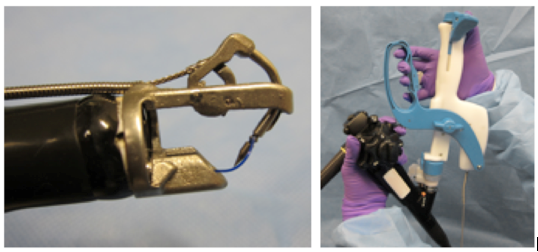
Technology Description: Ulcer oversewing was performed using a novel endoscopic suturing system (Figure 1).  The system attaches to a double-channel endoscope and utilizes a curved needle that allows the placement of a variety of stitch patterns, including running or interrupted, with a single insertion of the endoscope.
Methods: This is the case of a 71-year-old male with recurrent GI bleeding, starting one week following Roux-en-Y gastric bypass (RYGB).  A large marginal ulceration, roughly 1/3 the stomal circumference, was found on upper endoscopy (Figure 2A).  He was subsequently admitted five times for GI bleeding and required over 20 blood transfusions.  He again presented with melena and was transferred to our center for further management.  At presentation, he appeared nontoxic with stable vital signs. Abdominal exam was benign.  He was a poor surgical candidate due to a complicated medical history that included coronary artery disease with multiple stents, peripheral vascular disease with aorto-bifemoral bypass, DM, COPD, and OSA.  A decision was made to treat his ulcer using a novel endoscopic suturing system.  Video records were maintained.
Results: Two interrupted stitches were successfully placed into the tissue surrounding the ulcer bed using 2-0 polypropylene monofilament sutures.  Complete ulcer closure was achieved (Figure 2B).  Tisseel fibrin glue was applied to the sutured area.  The procedure was performed under general anesthesia and took less than 25 minutes.  It was well tolerated and there were no complications.  At 6 weeks post procedure, the patient reported complete resolution of his symptoms and repeat upper endoscopy demonstrated complete ulcer resolution (Figure 2C).
Conclusion: This case demonstrates the technical feasibility of stomal ulceration oversewing using a novel endoscopic suturing device.  This technique may provide an effective, minimally-invasive treatment alternative to operative intervention.  Further studies with this system are currently underway.
https://www.submitmyabstract.comhttps://www.submitmyabstract.com/abs/images/36266/Abstract-img.png

Figure 1.  A novel endoscopic suturing system.

Figure 2.  Endoscopic views showing stomal ulceration.  A. Before endoscopic oversewing.  B. At completion of procedure.  C. At 6-week repeat upper endoscopy.


Session: Emerging Technology
Program Number: ET015

Related


Hours & Info

15821 Ventura Blvd Ste 400
Encino, CA 91436

1-310-437-0544

[email protected]

Monday – Friday
8am to 5pm Pacific Time

Find Us Around the Web!

  • Bluesky
  • X
  • Instagram
  • Facebook
  • YouTube

Copyright © 2026 · SAGES · All Rights Reserved

Important Links

Healthy Sooner: Patient Information

SAGES Guidelines, Statements, & Standards of Practice

SAGES Manuals

Refine Search