• Skip to main content
  • Skip to header right navigation
  • Skip to site footer

Log in
www.sages.org

SAGES

Reimagining surgical care for a healthier world

  • Home
    • SAGES Home
    • SAGES Foundation Home
  • About
    • Awards
    • Who Is SAGES?
    • Leadership
    • Our Mission
    • Advocacy
    • Committees
      • SAGES Board of Governors
      • Officers and Representatives of the Society
      • Committee Chairs and Co-Chairs
      • Committee Rosters
      • SAGES Past Presidents
    • Why Should You Support SAGES?
    • SAGES Swag
  • Meetings
    • SAGES NBT Innovation Weekend
    • SAGES Annual Meeting
      • 2026 Annual Meeting
      • 2027 Scientific Session Call for Abstracts
      • 2027 Emerging Technology Call for Abstracts
    • CME Claim Form
    • SAGES Past, Present, Future, and Related Meeting Information
    • SAGES Related Meetings & Events Calendar
  • Join SAGES!
    • Membership Application
    • Membership Benefits
    • Membership Types
      • Requirements and Applications for Active Membership in SAGES
      • Requirements and Applications for Affiliate Membership in SAGES
      • Requirements and Applications for Associate Active Membership in SAGES
      • Requirements and Applications for Candidate Membership in SAGES
      • Requirements and Applications for International Membership in SAGES
      • Requirements for Medical Student Membership
    • Member Spotlight
    • Give the Gift of SAGES Membership
  • Patients
    • Join the SAGES Patient Partner Network (PPN)
    • Patient Information Brochures
    • Healthy Sooner – Patient Information for Minimally Invasive Surgery
    • Choosing Wisely – An Initiative of the ABIM Foundation
    • All in the Recovery: Colorectal Cancer Alliance
    • Find A SAGES Surgeon
  • Publications
    • Clinical / Practice / Training Guidelines, Statements, and Standards of Practice
    • Sustainability in Surgical Practice
    • SAGES Stories Podcast
    • SAGES Lead Up Podcast
    • Patient Information Brochures
    • Patient Information From SAGES
    • TAVAC – Technology and Value Assessments
    • Surgical Endoscopy and Other Journal Information
    • Innovative Surgical Trends
    • SAGES Manuals
    • MesSAGES – The SAGES Newsletter
    • COVID-19 Archive
    • Troubleshooting Guides
  • Education
    • Wellness Resources – You Are Not Alone
    • Avoid Opiates After Surgery
    • SAGES Subscription Catalog
    • SAGES TV: Home of SAGES Surgical Videos
    • The SAGES Safe Cholecystectomy Program
    • Masters Program
    • Resident and Fellow Opportunities
      • MIS Fellows Course
      • SAGES Robotics Residents and Fellows Courses
      • SAGES Free Resident Webinar Series
      • Advanced Laparoscopy and Fluorescence-Guided Surgery Course for Fellows
      • Fellows’ Career Development Course
    • SAGES S.M.A.R.T. Enhanced Recovery Program
    • SAGES @ Cine-Med Products
      • SAGES Top 21 Minimally Invasive Procedures Every Practicing Surgeon Should Know
      • SAGES Pearls Step-by-Step
      • SAGES Flexible Endoscopy 101
    • SAGES OR SAFETY Video Activity
    • Foregut Video Atlas
  • Opportunities
    • Join the SAGES Patient Partner Network (PPN)
    • Fellowship Recognition Opportunities
    • SAGES Advanced Flexible Endoscopy Area of Concentrated Training (ACT) SEAL
    • Multi-Society Foregut Fellowship Certification
    • Research Opportunities
    • FLS
    • FES
    • FUSE
    • Jobs Board
    • SAGES Go Global: Global Affairs
  • Learning Hub
You are here: Home / Abstracts / Reoperation Rates After Nissen Fundoplication: an Analysis of the California Outcomes Database (oshpd)

Reoperation Rates After Nissen Fundoplication: an Analysis of the California Outcomes Database (oshpd)

Cristina R Harnsberger, MD, Tianzan Zhou, BA, David C Chang, PhD, MPH, MBA, Ryan C Broderick, MD, Hans F Fuchs, MD, Garth R Jacobsen, MD, Santiago Horgan, MD, Bryan J Sandler, MD. University Of California, San Diego.

INTRODUCTION – Current literature on redo antireflux surgery has limitations due to small sample size or single center experiences. This study aims to evaluate the reoperation rate of uncomplicated laparoscopic Nissen fundoplication in a large population database.

METHODS AND PROCEDURES – A longitudinal version of the California Office of Statewide Health Planning and Development (OSHPD) database from 1995 to 2010 was used. This database includes all patients from every civilian hospital in California during this time period. Inclusion criteria were patients who received a laparoscopic Nissen fundoplication for uncomplicated GERD or hiatal hernia (types I-IV). Patients were excluded if they had complications of GERD, esophageal or gastric cancer, prior esophageal or gastric surgery, vagotomy, esophageal dysmotility, and diaphragmatic hernia with gangrene or obstruction. The outcome was reoperation, specified as another Nissen fundoplication or reversal (ICD 9 codes 44.66, 44.67, and 44.69). Censoring events included esophageal or gastric cancer and any other esophageal or gastric surgery. Analysis was carried out via a Kaplan-Meier plot, hazard curve, and multivariate analysis adjusting for age, race, gender, comorbidities, insurance status, hospital teaching status, and year of procedure.

RESULTS – 13,050 patients were included in the study. The five and ten-year cumulative reoperation rates were 5.2% (95%CI: 4.8-5.7%) and 6.9% (95%CI: 6.1-7.9%), respectively. Of these reoperations, 30.1% were performed at a different hospital from that of the initial fundoplication. Reoperation rate was highest at 1 year post-operatively (1.7% per year), and steadily declined until 4 years post-operatively, after which it remained at approximately 0.5% per year. Multivariate analysis demonstrated significantly higher rates of reoperation among younger patients (HR=3.56, 95%CI: 2.29-5.57 for <30yo; HR=1.89, 95%CI: 1.25-2.87 for 30-50yo; HR=1.65, 95%CI: 1.11-2.46 for 50-65yo) and female patients (HR=1.35, 95%CI: 1.12-1.63).
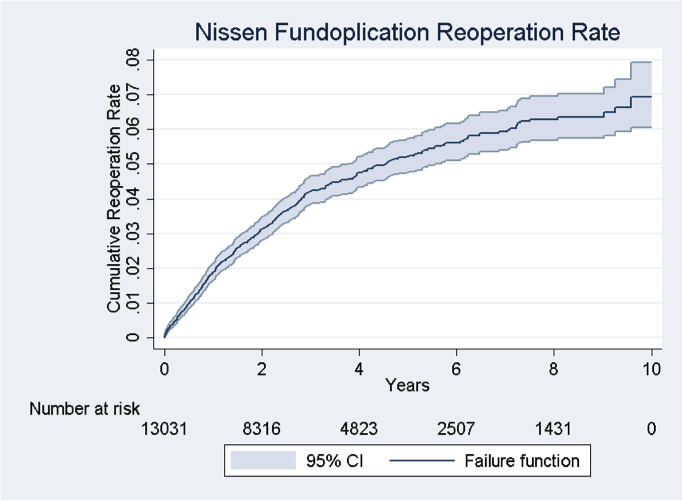
CONCLUSION(S) – Nearly one third of reoperations after failed Nissen fundoplication occur at a hospital different from the initial operation, which raises concern that existing literature does not reflect the true reoperation rate. The reoperation rate is highest in the first year postoperatively. The reasons for the higher rate of reoperation in females and younger patients remain unclear, and warrant further study.
 

Related


Hours & Info

15821 Ventura Blvd Ste 400
Encino, CA 91436

1-310-437-0544

[email protected]

Monday – Friday
8am to 5pm Pacific Time

Find Us Around the Web!

  • Bluesky
  • X
  • Instagram
  • Facebook
  • YouTube

Copyright © 2026 · SAGES · All Rights Reserved

Important Links

Healthy Sooner: Patient Information

SAGES Guidelines, Statements, & Standards of Practice

SAGES Manuals

Refine Search