• Skip to main content
  • Skip to header right navigation
  • Skip to site footer

Log in
www.sages.org

SAGES

Reimagining surgical care for a healthier world

  • Home
    • SAGES Home
    • SAGES Foundation Home
  • About
    • Awards
    • Who Is SAGES?
    • Leadership
    • Our Mission
    • Advocacy
    • Committees
      • SAGES Board of Governors
      • Officers and Representatives of the Society
      • Committee Chairs and Co-Chairs
      • Committee Rosters
      • SAGES Past Presidents
    • Why Should You Support SAGES?
    • SAGES Swag
  • Meetings
    • SAGES NBT Innovation Weekend
    • SAGES Annual Meeting
      • 2026 Annual Meeting
      • 2027 Scientific Session Call for Abstracts
      • 2027 Emerging Technology Call for Abstracts
    • CME Claim Form
    • SAGES Past, Present, Future, and Related Meeting Information
    • SAGES Related Meetings & Events Calendar
  • Join SAGES!
    • Membership Application
    • Membership Benefits
    • Membership Types
      • Requirements and Applications for Active Membership in SAGES
      • Requirements and Applications for Affiliate Membership in SAGES
      • Requirements and Applications for Associate Active Membership in SAGES
      • Requirements and Applications for Candidate Membership in SAGES
      • Requirements and Applications for International Membership in SAGES
      • Requirements for Medical Student Membership
    • Member Spotlight
    • Give the Gift of SAGES Membership
  • Patients
    • Join the SAGES Patient Partner Network (PPN)
    • Patient Information Brochures
    • Healthy Sooner – Patient Information for Minimally Invasive Surgery
    • Choosing Wisely – An Initiative of the ABIM Foundation
    • All in the Recovery: Colorectal Cancer Alliance
    • Find A SAGES Surgeon
  • Publications
    • Clinical / Practice / Training Guidelines, Statements, and Standards of Practice
    • Sustainability in Surgical Practice
    • SAGES Stories Podcast
    • SAGES Lead Up Podcast
    • Patient Information Brochures
    • Patient Information From SAGES
    • TAVAC – Technology and Value Assessments
    • Surgical Endoscopy and Other Journal Information
    • Innovative Surgical Trends
    • SAGES Manuals
    • MesSAGES – The SAGES Newsletter
    • COVID-19 Archive
    • Troubleshooting Guides
  • Education
    • Wellness Resources – You Are Not Alone
    • Avoid Opiates After Surgery
    • SAGES Subscription Catalog
    • SAGES TV: Home of SAGES Surgical Videos
    • The SAGES Safe Cholecystectomy Program
    • Masters Program
    • Resident and Fellow Opportunities
      • MIS Fellows Course
      • SAGES Robotics Residents and Fellows Courses
      • SAGES Free Resident Webinar Series
      • Advanced Laparoscopy and Fluorescence-Guided Surgery Course for Fellows
      • Fellows’ Career Development Course
    • SAGES S.M.A.R.T. Enhanced Recovery Program
    • SAGES @ Cine-Med Products
      • SAGES Top 21 Minimally Invasive Procedures Every Practicing Surgeon Should Know
      • SAGES Pearls Step-by-Step
      • SAGES Flexible Endoscopy 101
    • SAGES OR SAFETY Video Activity
    • Foregut Video Atlas
  • Opportunities
    • Join the SAGES Patient Partner Network (PPN)
    • Fellowship Recognition Opportunities
    • SAGES Advanced Flexible Endoscopy Area of Concentrated Training (ACT) SEAL
    • Multi-Society Foregut Fellowship Certification
    • Research Opportunities
    • FLS
    • FES
    • FUSE
    • Jobs Board
    • SAGES Go Global: Global Affairs
  • Learning Hub
You are here: Home / Abstracts / Prediction of Excess Weight Loss after Laparoscopic Roux-en-Y Gastric Bypass Using an Artificial Neural Network

Prediction of Excess Weight Loss after Laparoscopic Roux-en-Y Gastric Bypass Using an Artificial Neural Network

Eric S Wise, MD1, Kyle M Hocking, ME, PhD1, Stephen M Kavic, MD2, Colleen M Brophy, MD1. 1Vanderbilt University, 2University of Maryland

Introduction:

Laparoscopic Roux-en-Y Gastric Bypass (LRYGB) has become the gold standard for surgical weight loss in the morbidly obese. The success of LRYGB may be measured by excess weight loss (EWL), and several variables have been identified as independent pre-operative predictors of EWL. However, current models of estimating EWL, based on multivariate regression analysis, are poorly prognostic. Artificial neural networks (ANN) are advanced, continually adapting computational systems taught to identify complex non-linear relationships among variables correlated with an outcome. We used ANN modeling to derive a reasonable estimate of expected post-operative weight loss using known pre-operative variables. Additionally, we used ANN modeling to predict whether 50% excess weight loss will be achieved by one year postoperatively.

Methods:

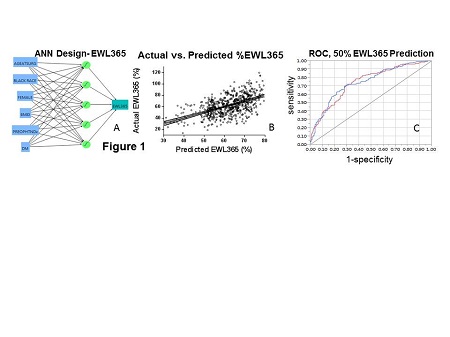
1621 patients who have undergone bariatric LRYGB with a Roux limb <150 cm from 2004-2013 were reviewed. Of these, 647 patients had sufficient data for analysis. Endpoints were %EWL at 180 and 365 days (EWL180 and EWL365, respectively). Previously validated pre-operative factors were analyzed, including age; race; gender; pre-operative BMI (BMI0); hemoglobin; and previous diagnosis of hypertension (HTN), diabetes mellitus (DM), or psychiatric disorder. Variables associated with EWL in bivariate analysis (P<0.1) were included in multivariate linear regression (MLR). Variables significant in MLR (P<0.05) were input into five-node back-propagation ANNs (ANN180 and ANN365 [Figure 1A]). The ANN output is an estimation of %EWL. Using ANN modeling, a receiver operating characteristic curve was generated to predict 50% EWL at 365 days.

Results:

The average patient age was 47.0±11.0 years, and the average BMI0 was 48.5±8.5 kg/m2. In bivariate analysis, EWL180 was associated with hemoglobin, DM, HTN, BMI0, male gender and black race. EWL365 was associated with these factors with the addition of age. In MLR, independent risk factors for decreased EWL180 included DM (P<0.0001), HTN (P=0.0022), higher BMI0 (P<0.0001), male gender (P=0.0311) and black race (P<0.0001). For EWL365, independent risk factors were DM, HTN, higher BMI0, black race, male gender (all P<0.0001) and advanced age (P=0.0237). Actual vs. ANN-Predicted EWL plots were generated for EWL180 and EWL365 (Figure 1B), with Pearson r correlation coefficients of 0.5567 and 0.5479, respectively (P<0.0001). ANN prediction of benchmark 50% EWL at 365 days generated an area under the curve of 0.7454±0.02 in the training set (n=518, Figure 1C), and 0.7796±0.04 (n=129) in the validation set. A prototype web-based EWL estimator was then designed.

Conclusions:

Successful postsurgical weight loss is dependent on multiple preoperative and postoperative factors. The ANN model demonstrated age, DM, HTN, BMI0, black race and male gender as independent markers for a less successful operation. Using an easily obtainable and quantifiable subset of independent pre-operative predictors, an ANN model allows for development of a patient-centered tool with which to obtain an optimized estimate of post-surgical EWL at 6 and 12 months. Bariatric surgeons may opt to incorporate this model as a screening tool, or for patients to access, to assess the likelihood of meeting their goals.
image

Related


Hours & Info

15821 Ventura Blvd Ste 400
Encino, CA 91436

1-310-437-0544

[email protected]

Monday – Friday
8am to 5pm Pacific Time

Find Us Around the Web!

  • Bluesky
  • X
  • Instagram
  • Facebook
  • YouTube

Copyright © 2026 · SAGES · All Rights Reserved

Important Links

Healthy Sooner: Patient Information

SAGES Guidelines, Statements, & Standards of Practice

SAGES Manuals

Refine Search