• Skip to main content
  • Skip to header right navigation
  • Skip to site footer

Log in
www.sages.org

SAGES

Reimagining surgical care for a healthier world

  • Home
    • SAGES Home
    • SAGES Foundation Home
  • About
    • Awards
    • Who Is SAGES?
    • Leadership
    • Our Mission
    • Advocacy
    • Committees
      • SAGES Board of Governors
      • Officers and Representatives of the Society
      • Committee Chairs and Co-Chairs
      • Committee Rosters
      • SAGES Past Presidents
    • Why Should You Support SAGES?
    • SAGES Swag
  • Meetings
    • SAGES NBT Innovation Weekend
    • SAGES Annual Meeting
      • 2026 Annual Meeting
      • 2027 Scientific Session Call for Abstracts
      • 2027 Emerging Technology Call for Abstracts
    • CME Claim Form
    • SAGES Past, Present, Future, and Related Meeting Information
    • SAGES Related Meetings & Events Calendar
  • Join SAGES!
    • Membership Application
    • Membership Benefits
    • Membership Types
      • Requirements and Applications for Active Membership in SAGES
      • Requirements and Applications for Affiliate Membership in SAGES
      • Requirements and Applications for Associate Active Membership in SAGES
      • Requirements and Applications for Candidate Membership in SAGES
      • Requirements and Applications for International Membership in SAGES
      • Requirements for Medical Student Membership
    • Member Spotlight
    • Give the Gift of SAGES Membership
  • Patients
    • Join the SAGES Patient Partner Network (PPN)
    • Patient Information Brochures
    • Healthy Sooner – Patient Information for Minimally Invasive Surgery
    • Choosing Wisely – An Initiative of the ABIM Foundation
    • All in the Recovery: Colorectal Cancer Alliance
    • Find A SAGES Surgeon
  • Publications
    • Clinical / Practice / Training Guidelines, Statements, and Standards of Practice
    • Sustainability in Surgical Practice
    • SAGES Stories Podcast
    • SAGES Lead Up Podcast
    • Patient Information Brochures
    • Patient Information From SAGES
    • TAVAC – Technology and Value Assessments
    • Surgical Endoscopy and Other Journal Information
    • Innovative Surgical Trends
    • SAGES Manuals
    • MesSAGES – The SAGES Newsletter
    • COVID-19 Archive
    • Troubleshooting Guides
  • Education
    • Wellness Resources – You Are Not Alone
    • Avoid Opiates After Surgery
    • SAGES Subscription Catalog
    • SAGES TV: Home of SAGES Surgical Videos
    • The SAGES Safe Cholecystectomy Program
    • Masters Program
    • Resident and Fellow Opportunities
      • MIS Fellows Course
      • SAGES Robotics Residents and Fellows Courses
      • SAGES Free Resident Webinar Series
      • Advanced Laparoscopy and Fluorescence-Guided Surgery Course for Fellows
      • Fellows’ Career Development Course
    • SAGES S.M.A.R.T. Enhanced Recovery Program
    • SAGES @ Cine-Med Products
      • SAGES Top 21 Minimally Invasive Procedures Every Practicing Surgeon Should Know
      • SAGES Pearls Step-by-Step
      • SAGES Flexible Endoscopy 101
    • SAGES OR SAFETY Video Activity
    • Foregut Video Atlas
  • Opportunities
    • Join the SAGES Patient Partner Network (PPN)
    • Fellowship Recognition Opportunities
    • SAGES Advanced Flexible Endoscopy Area of Concentrated Training (ACT) SEAL
    • Multi-Society Foregut Fellowship Certification
    • Research Opportunities
    • FLS
    • FES
    • FUSE
    • Jobs Board
    • SAGES Go Global: Global Affairs
  • Learning Hub
You are here: Home / Abstracts / Platelet-Rich Plasma (PRP) Decreases Incidence of Hernia Recurrence Using Strattice(tm) Mesh in a Rodent Model of Chronic Ventral Hernia Repair

Platelet-Rich Plasma (PRP) Decreases Incidence of Hernia Recurrence Using Strattice(tm) Mesh in a Rodent Model of Chronic Ventral Hernia Repair

Jeffrey L Van Eps, MD1, Joseph S Fernandez-Moure, MD, MS1, Fernando J Cabrera, MD2, Bradley K Weiner, MD1, Ennio Tasciotti, PhD2, Brian J Dunkin, MD, FACS3, Warren A Ellsworth IV, MD, FACS4. 1Houston Methodist Hospital & Surgical Advanced Technology Lab, Houston Methodist Research Institute, 2Surgical Advanced Technology Lab, Houston Methodist Research Institute, 3Houston Methodist Hospital, Methodist Institute for Technology, Innovation and Education (MITIE), 4Houston Methodist Hospital

Introduction: High hernia recurrence rates witnessed with use of acellular dermal matrices (ADMs) for ventral hernia repair (VHR) have largely relegated them to bridging therapy before definitive synthetic mesh repair or breast surgery. PRP is a universally available, personalized product that when activated, releases a host of growth factors capable of augmenting soft tissue repair. Its effectiveness has been validated in many plastic surgery and orthopedic applications, but its benefit has not been explored as it applies to VHR. We hypothesized that the addition of PRP would enhance Strattice™ longevity via increased tissue deposition and protection from immunologic degradation, thus resulting in decreased hernia recurrence due to mesh failure at 6 months in a rodent model of chronic VHR.

Methods/Procedures: Chronic ventral hernias were created in 42 Lewis rats via a 3cm incision of the linea alba, followed by skin closure and hernia maturation for >28 days. Rats were randomly assigned to either a Strattice™ control (A) or PRP-treated Strattice™ (B) group and either 3 or 6-month time point. All repairs were done in underlay fashion. Autologous PRP (1×10⁶ platelets/uL) was isolated preoperatively for experimental rats via double-centrifugation of whole blood (8mL), activated with thrombin, and applied to the mesh surface at the time of implantation. Animals were sacrificed at 3 and 6 months postoperatively, specimens harvested en bloc with surrounding abdominal wall, and either histologically processed to compare tissue deposition, neovascularization, mesh thickness and integrity (N=24), or preserved by vitrification for biaxial biomechanical stress testing (N=18). Adhesion severity was scored at necropsy according to a modified Hopkins Adhesion Scoring system.

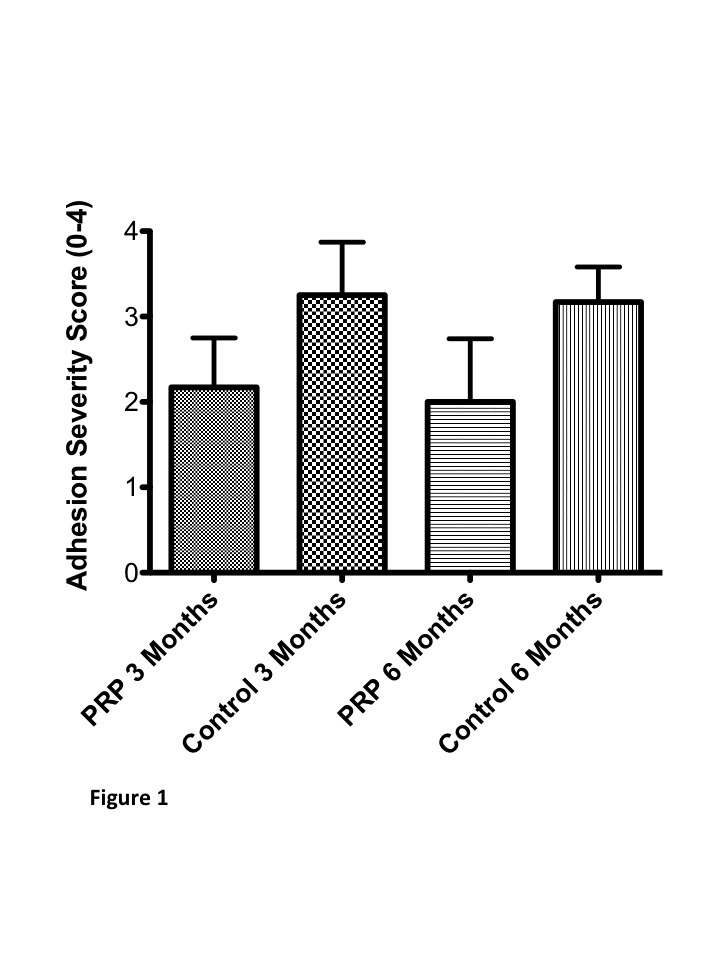
Results: At 3 months, no hernia recurrence was noted in either group. However, at 6-month necropsy, all control rats displayed mesh failure and hernia recurrence compared to none of group B PRP-treated rats. Group B rats also had lower adhesion severity scores at both 3 months (2.17 +/- 0.58 vs. 3.25 +/- 0.62) and 6 months (2.00 +/- 0.74 vs. 3.17 +/- 0.41) (Figure 1). PRP-treated mesh underwent significantly less degradation, with residual mesh thickness over 3-fold greater than control at both areas of muscular overlap and mesh center (p<0.05, Figure 2). Histologically, PRP-treated mesh displayed enhanced tissue deposition/incorporation and more robust neovascularization than controls. Final biomechanical stress testing results are pending, but preliminary data supports greater tensile strength in PRP-treated samples of Group B.

Conclusions: Our data supports PRP’s ability to safely augment VHR with ADM at the macroscopic level, with less frequent or severe adhesion formation, less hernia recurrence, and greater long-term mechanical longevity – all due to its microscopic local tissue effects that favor a regenerative response of neovascularization, tissue incorporation, and avoidance of immunologic degradation. PRP is a safe, personalized, and universally available resource with apparent usefulness in surgery and regenerative medicine, and such evidence supports ongoing investigation into its role in VHR and soft tissue repair. Future randomized human studies would help answer this query and are warranted.
imageimage

Related


Hours & Info

15821 Ventura Blvd Ste 400
Encino, CA 91436

1-310-437-0544

[email protected]

Monday – Friday
8am to 5pm Pacific Time

Find Us Around the Web!

  • Bluesky
  • X
  • Instagram
  • Facebook
  • YouTube

Copyright © 2026 · SAGES · All Rights Reserved

Important Links

Healthy Sooner: Patient Information

SAGES Guidelines, Statements, & Standards of Practice

SAGES Manuals

Refine Search