• Skip to main content
  • Skip to header right navigation
  • Skip to site footer

Log in
www.sages.org

SAGES

Reimagining surgical care for a healthier world

  • Home
    • SAGES Home
    • SAGES Foundation Home
  • About
    • Awards
    • Who Is SAGES?
    • Leadership
    • Our Mission
    • Advocacy
    • Committees
      • SAGES Board of Governors
      • Officers and Representatives of the Society
      • Committee Chairs and Co-Chairs
      • Committee Rosters
      • SAGES Past Presidents
    • Why Should You Support SAGES?
    • SAGES Swag
  • Meetings
    • SAGES NBT Innovation Weekend
    • SAGES Annual Meeting
      • 2026 Annual Meeting
      • 2027 Scientific Session Call for Abstracts
      • 2027 Emerging Technology Call for Abstracts
    • CME Claim Form
    • SAGES Past, Present, Future, and Related Meeting Information
    • SAGES Related Meetings & Events Calendar
  • Join SAGES!
    • Membership Application
    • Membership Benefits
    • Membership Types
      • Requirements and Applications for Active Membership in SAGES
      • Requirements and Applications for Affiliate Membership in SAGES
      • Requirements and Applications for Associate Active Membership in SAGES
      • Requirements and Applications for Candidate Membership in SAGES
      • Requirements and Applications for International Membership in SAGES
      • Requirements for Medical Student Membership
    • Member Spotlight
    • Give the Gift of SAGES Membership
  • Patients
    • Join the SAGES Patient Partner Network (PPN)
    • Patient Information Brochures
    • Healthy Sooner – Patient Information for Minimally Invasive Surgery
    • Choosing Wisely – An Initiative of the ABIM Foundation
    • All in the Recovery: Colorectal Cancer Alliance
    • Find A SAGES Surgeon
  • Publications
    • Clinical / Practice / Training Guidelines, Statements, and Standards of Practice
    • Sustainability in Surgical Practice
    • SAGES Stories Podcast
    • SAGES Lead Up Podcast
    • Patient Information Brochures
    • Patient Information From SAGES
    • TAVAC – Technology and Value Assessments
    • Surgical Endoscopy and Other Journal Information
    • Innovative Surgical Trends
    • SAGES Manuals
    • MesSAGES – The SAGES Newsletter
    • COVID-19 Archive
    • Troubleshooting Guides
  • Education
    • Wellness Resources – You Are Not Alone
    • Avoid Opiates After Surgery
    • SAGES Subscription Catalog
    • SAGES TV: Home of SAGES Surgical Videos
    • The SAGES Safe Cholecystectomy Program
    • Masters Program
    • Resident and Fellow Opportunities
      • MIS Fellows Course
      • SAGES Robotics Residents and Fellows Courses
      • SAGES Free Resident Webinar Series
      • Advanced Laparoscopy and Fluorescence-Guided Surgery Course for Fellows
      • Fellows’ Career Development Course
    • SAGES S.M.A.R.T. Enhanced Recovery Program
    • SAGES @ Cine-Med Products
      • SAGES Top 21 Minimally Invasive Procedures Every Practicing Surgeon Should Know
      • SAGES Pearls Step-by-Step
      • SAGES Flexible Endoscopy 101
    • SAGES OR SAFETY Video Activity
    • Foregut Video Atlas
  • Opportunities
    • Join the SAGES Patient Partner Network (PPN)
    • Fellowship Recognition Opportunities
    • SAGES Advanced Flexible Endoscopy Area of Concentrated Training (ACT) SEAL
    • Multi-Society Foregut Fellowship Certification
    • Research Opportunities
    • FLS
    • FES
    • FUSE
    • Jobs Board
    • SAGES Go Global: Global Affairs
  • Learning Hub
You are here: Home / Abstracts / Establishment of Gastrectomy and Hepatectomy By Multi Piercing Surgery (needle Surgery with NOTES) Using 3-Mm Diameter Devices: Ultra Minimally Invasive Surgery Allowing the Triangular Formation That Replaces Single Port Surgery

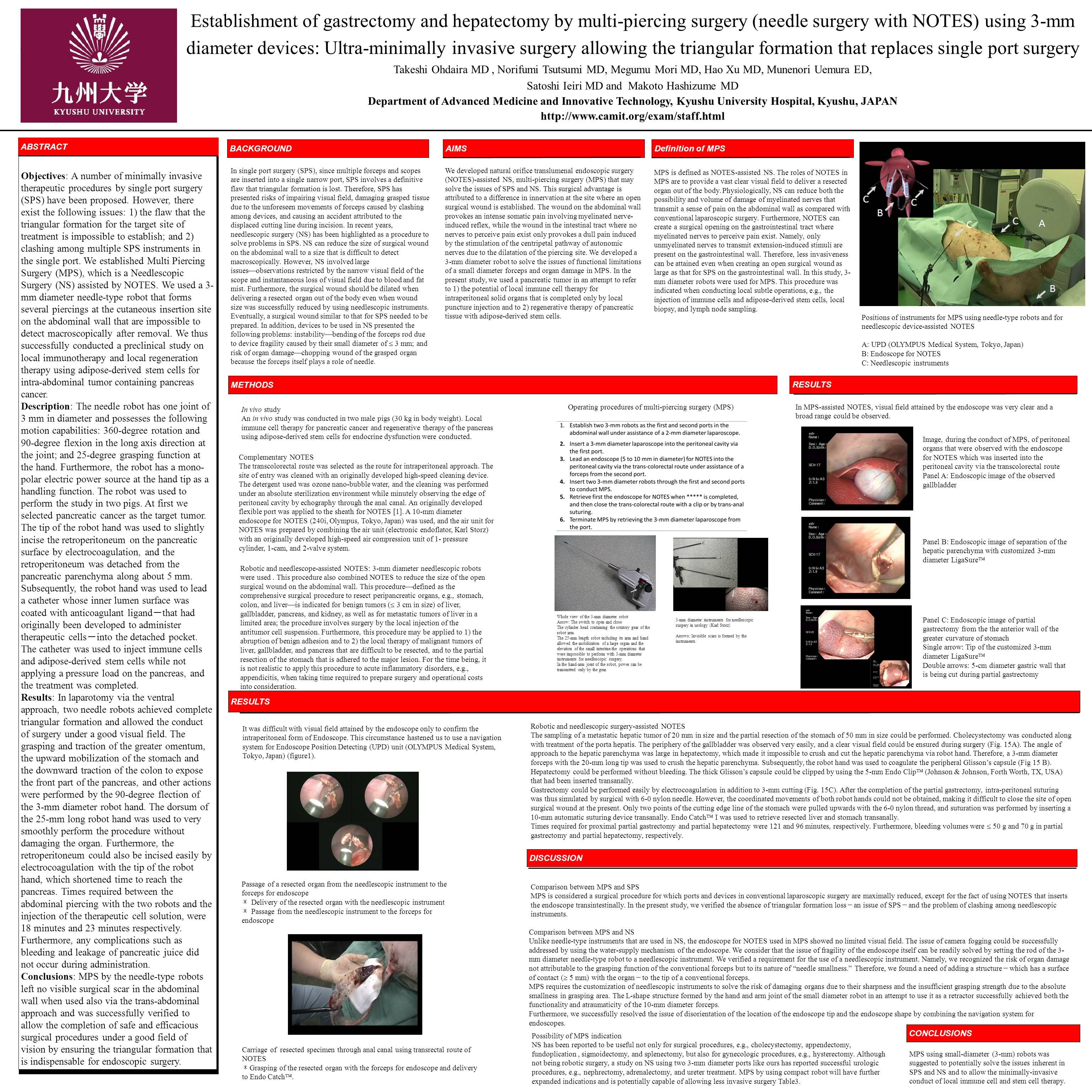
Establishment of Gastrectomy and Hepatectomy By Multi Piercing Surgery (needle Surgery with NOTES) Using 3-Mm Diameter Devices: Ultra Minimally Invasive Surgery Allowing the Triangular Formation That Replaces Single Port Surgery

Takeshi Ohdaira, MD, Norifumi Tsutsumi, MD, Megumu Mori, MD, Kyo Jo, MD, Makoto Hashizume, MD. Department of Advanced Medicine and Innovative Technology, Kyushu University Hospital

Objectives: A number of minimally invasive surgical procedures by Single Port Surgery (SPS) have been proposed. However, there exist the following issues: 1) the fatal flaw that the triangular formation for the target site of treatment, which is indispensable for endoscopic surgery, is impossible to establish; and 2) the issue of clashing among forceps in the endoscope port. We successfully established Multi Piercing Surgery (MPS), which is a Needlescopic Surgery (NS) assisted by NOTES. In this study, we conducted gastrectomy and hepatectomy by MPS using the 3-mm diameter needle-type instruments through the opening at the cutaneous that is impossible to detect macroscopically. The flaw of small-diameter needle surgery the low resolution of the monitor diameter was resolved by concurrently using the high-resolution endoscope for NOTES and performing NOTES whose procedures were simplified to prevent surgical opening dilatation which may occur when removing resected organs out of the body. This method permits ultra-minimally invasive surgery by using the low pain of the micro abdominal opening and the markedly high pain threshold of the intestine in NOTES. Description: Surgery was performed with a total of four instruments for transabdominal surgery, i.e., two 3-mm diameter forceps, one knife, and one stripping forceps. NOTES used the transrectal route and the 10-mm diameter endoscope. Ozon nano-babble water allowing complete intestinal lavage in a short time was used for NOTES. Two pigs were used to perform hepatectomy. An opening for needle device insertion was established in the abdominal wall where the triangle formation for the target organ was ensured. Gastrectomy: Partial gastrectomy including D1 dissection was performed. A 10-mm diameter auto cutter was inserted via the transanal route. Hepatectomy: A 3-mm bipolar device for incision was manufactured originally to perform lateral segmentectomy. End-catch I was used to transanally remove both the stomach and the liver. Results: The needle device allowed the establishment of the complete triangular formation, which constantly permitted the conduct of surgery under a good field of vision. Furthermore, a retroperitoneal incision for lymph node dissection could be performed easily by electrocoagulation with the tip of the 3-mm diameter forceps. Times required to perform proximal partial gastrectomy and hepatectomy were 121 minutes and 96 minutes, respectively. Furthermore, volumes of bleeding during resection were ? 50 g and 71 g in gastrectomy and hepatectomy, respectively. Conclusions: MPS left no surgical scar in the abdominal wall when used via transabdominal route and was successfully verified to allow the completion of safe and efficacious surgical procedures under a good field of vision by ensuring the triangular formation that is indispensable for endoscopic surgery.


Session: Emerging Technology Poster
Program Number: ETP010
View Poster
Related


Hours & Info

15821 Ventura Blvd Ste 400
Encino, CA 91436

1-310-437-0544

[email protected]

Monday – Friday
8am to 5pm Pacific Time

Find Us Around the Web!

  • Bluesky
  • X
  • Instagram
  • Facebook
  • YouTube

Copyright © 2026 · SAGES · All Rights Reserved

Important Links

Healthy Sooner: Patient Information

SAGES Guidelines, Statements, & Standards of Practice

SAGES Manuals