• Skip to main content
  • Skip to header right navigation
  • Skip to site footer

Log in
www.sages.org

SAGES

Reimagining surgical care for a healthier world

  • Home
    • SAGES Home
    • SAGES Foundation Home
  • About
    • Awards
    • Who Is SAGES?
    • Leadership
    • Our Mission
    • Advocacy
    • Committees
      • SAGES Board of Governors
      • Officers and Representatives of the Society
      • Committee Chairs and Co-Chairs
      • Committee Rosters
      • SAGES Past Presidents
    • Why Should You Support SAGES?
    • SAGES Swag
  • Meetings
    • SAGES NBT Innovation Weekend
    • SAGES Annual Meeting
      • 2026 Annual Meeting
      • 2027 Scientific Session Call for Abstracts
      • 2027 Emerging Technology Call for Abstracts
    • CME Claim Form
    • SAGES Past, Present, Future, and Related Meeting Information
    • SAGES Related Meetings & Events Calendar
  • Join SAGES!
    • Membership Application
    • Membership Benefits
    • Membership Types
      • Requirements and Applications for Active Membership in SAGES
      • Requirements and Applications for Affiliate Membership in SAGES
      • Requirements and Applications for Associate Active Membership in SAGES
      • Requirements and Applications for Candidate Membership in SAGES
      • Requirements and Applications for International Membership in SAGES
      • Requirements for Medical Student Membership
    • Member Spotlight
    • Give the Gift of SAGES Membership
  • Patients
    • Join the SAGES Patient Partner Network (PPN)
    • Patient Information Brochures
    • Healthy Sooner – Patient Information for Minimally Invasive Surgery
    • Choosing Wisely – An Initiative of the ABIM Foundation
    • All in the Recovery: Colorectal Cancer Alliance
    • Find A SAGES Surgeon
  • Publications
    • Clinical / Practice / Training Guidelines, Statements, and Standards of Practice
    • Sustainability in Surgical Practice
    • SAGES Stories Podcast
    • SAGES Lead Up Podcast
    • Patient Information Brochures
    • Patient Information From SAGES
    • TAVAC – Technology and Value Assessments
    • Surgical Endoscopy and Other Journal Information
    • Innovative Surgical Trends
    • SAGES Manuals
    • MesSAGES – The SAGES Newsletter
    • COVID-19 Archive
    • Troubleshooting Guides
  • Education
    • Wellness Resources – You Are Not Alone
    • Avoid Opiates After Surgery
    • SAGES Subscription Catalog
    • SAGES TV: Home of SAGES Surgical Videos
    • The SAGES Safe Cholecystectomy Program
    • Masters Program
    • Resident and Fellow Opportunities
      • MIS Fellows Course
      • SAGES Robotics Residents and Fellows Courses
      • SAGES Free Resident Webinar Series
      • Advanced Laparoscopy and Fluorescence-Guided Surgery Course for Fellows
      • Fellows’ Career Development Course
    • SAGES S.M.A.R.T. Enhanced Recovery Program
    • SAGES @ Cine-Med Products
      • SAGES Top 21 Minimally Invasive Procedures Every Practicing Surgeon Should Know
      • SAGES Pearls Step-by-Step
      • SAGES Flexible Endoscopy 101
    • SAGES OR SAFETY Video Activity
    • Foregut Video Atlas
  • Opportunities
    • Join the SAGES Patient Partner Network (PPN)
    • Fellowship Recognition Opportunities
    • SAGES Advanced Flexible Endoscopy Area of Concentrated Training (ACT) SEAL
    • Multi-Society Foregut Fellowship Certification
    • Research Opportunities
    • FLS
    • FES
    • FUSE
    • Jobs Board
    • SAGES Go Global: Global Affairs
  • Learning Hub
You are here: Home / Abstracts / An Information-Rich Technology for Comprehensive Evaluation of the Human-Machine Interaction in Robotic Surgery

An Information-Rich Technology for Comprehensive Evaluation of the Human-Machine Interaction in Robotic Surgery

Konstantin Umanskiy, MD, Marie Ziesat, MD, William Hrdina, Saeed Richardson, Stephen Small, MD. University of Chicago Departments of Surgery and Anesthesia. University of Chicago Simulation Center
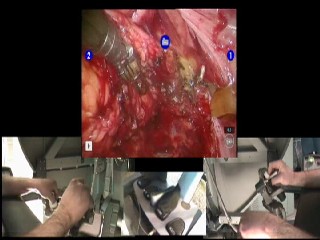
Fig. 1

Objective of the technology
The currently available surgical robot (da Vinci, Intutive Surgical, Sunnyvale, CA) is an electromechanical manipulator that is fully controlled by a human operator. In contrast to conventional or laparoscopic surgery, robotic surgery is performed via remote console that eliminates direct interaction between the surgeon and the patient. Thus, the surgeon only interacts directly with the robot, which in turn interacts with the patient. An additional level of complexity is added through control of the camera and position of the masters-manipulators via a series of foot pedals. All communication with the surgical team (anesthesia, assistant, etc) occurs via robotic microphone and speakers. These complex interactions have not been studied. Conventional training techniques used in laparoscopic surgery focus on observation or measurements of task accuracy, force used, and time to completion. Rapid adaptation of robotic technology increases the need to develop a comprehensive technique to capture a surgeon’s performance to be used in training, assessment, and possibly credentialing process. We developed a novel technique to record and evaluate all aspects of robotic surgery by combining video and audio information of human-machine and machine-patient interaction during a live surgical operation.

Description of the technology and method of its application
We record video feed from four sources as well as audio communication simultaneously during a live robotic surgical operation. Two camcorders are used to record the movements of the surgeon’s right and left hands, while a webcam mounted underneath a hand rest captures foot controls. The robotic camera itself captures a separate video. All video and audio feeds are combined on a single screen during post-recording processing to provide a complete representation of surgeon’s operative performance (Fig. 1).

Conclusions/Future directions
In this pilot study we present a technique for simultaneous acquisition of the information combined in a single screen format for a comprehensive assessment of the surgeon’s performance during the live surgical operation. This approach could be used for capturing the expert surgeon’s performance that can then serve as a part of a cognitive task analysis to elucidate the specific aspects of the advanced robotic surgical technique that are easily overlooked if only robotic camera recording is used. The information obtained from the expert performance can be used in designing training curriculum, assessing the trainee’s progress, or for credentialing of the surgeons to perform robotic surgical operations.


Session: Emerging Technology Poster
Program Number: ETP054
View Poster

Related


Hours & Info

15821 Ventura Blvd Ste 400
Encino, CA 91436

1-310-437-0544

[email protected]

Monday – Friday
8am to 5pm Pacific Time

Find Us Around the Web!

  • Bluesky
  • X
  • Instagram
  • Facebook
  • YouTube

Copyright © 2026 · SAGES · All Rights Reserved

Important Links

Healthy Sooner: Patient Information

SAGES Guidelines, Statements, & Standards of Practice

SAGES Manuals