• Skip to main content
  • Skip to header right navigation
  • Skip to site footer

Log in
www.sages.org

SAGES

Reimagining surgical care for a healthier world

  • Home
    • SAGES Home
    • SAGES Foundation Home
  • About
    • Awards
    • Who Is SAGES?
    • Leadership
    • Our Mission
    • Advocacy
    • Committees
      • SAGES Board of Governors
      • Officers and Representatives of the Society
      • Committee Chairs and Co-Chairs
      • Committee Rosters
      • SAGES Past Presidents
    • Why Should You Support SAGES?
    • SAGES Swag
  • Meetings
    • SAGES NBT Innovation Weekend
    • SAGES Annual Meeting
      • 2026 Annual Meeting
      • 2027 Scientific Session Call for Abstracts
      • 2027 Emerging Technology Call for Abstracts
    • CME Claim Form
    • SAGES Past, Present, Future, and Related Meeting Information
    • SAGES Related Meetings & Events Calendar
  • Join SAGES!
    • Membership Application
    • Membership Benefits
    • Membership Types
      • Requirements and Applications for Active Membership in SAGES
      • Requirements and Applications for Affiliate Membership in SAGES
      • Requirements and Applications for Associate Active Membership in SAGES
      • Requirements and Applications for Candidate Membership in SAGES
      • Requirements and Applications for International Membership in SAGES
      • Requirements for Medical Student Membership
    • Member Spotlight
    • Give the Gift of SAGES Membership
  • Patients
    • Join the SAGES Patient Partner Network (PPN)
    • Patient Information Brochures
    • Healthy Sooner – Patient Information for Minimally Invasive Surgery
    • Choosing Wisely – An Initiative of the ABIM Foundation
    • All in the Recovery: Colorectal Cancer Alliance
    • Find A SAGES Surgeon
  • Publications
    • Clinical / Practice / Training Guidelines, Statements, and Standards of Practice
    • Sustainability in Surgical Practice
    • SAGES Stories Podcast
    • SAGES Lead Up Podcast
    • Patient Information Brochures
    • Patient Information From SAGES
    • TAVAC – Technology and Value Assessments
    • Surgical Endoscopy and Other Journal Information
    • Innovative Surgical Trends
    • SAGES Manuals
    • MesSAGES – The SAGES Newsletter
    • COVID-19 Archive
    • Troubleshooting Guides
  • Education
    • Wellness Resources – You Are Not Alone
    • Avoid Opiates After Surgery
    • SAGES Subscription Catalog
    • SAGES TV: Home of SAGES Surgical Videos
    • The SAGES Safe Cholecystectomy Program
    • Masters Program
    • Resident and Fellow Opportunities
      • MIS Fellows Course
      • SAGES Robotics Residents and Fellows Courses
      • SAGES Free Resident Webinar Series
      • Advanced Laparoscopy and Fluorescence-Guided Surgery Course for Fellows
      • Fellows’ Career Development Course
    • SAGES S.M.A.R.T. Enhanced Recovery Program
    • SAGES @ Cine-Med Products
      • SAGES Top 21 Minimally Invasive Procedures Every Practicing Surgeon Should Know
      • SAGES Pearls Step-by-Step
      • SAGES Flexible Endoscopy 101
    • SAGES OR SAFETY Video Activity
    • Foregut Video Atlas
  • Opportunities
    • Join the SAGES Patient Partner Network (PPN)
    • Fellowship Recognition Opportunities
    • SAGES Advanced Flexible Endoscopy Area of Concentrated Training (ACT) SEAL
    • Multi-Society Foregut Fellowship Certification
    • Research Opportunities
    • FLS
    • FES
    • FUSE
    • Jobs Board
    • SAGES Go Global: Global Affairs
  • Learning Hub
You are here: Home / Abstracts / Giant HH with pancreatic prolapse: Report of a case

Giant HH with pancreatic prolapse: Report of a case

Kunihito Suzuki, MD, Yosuke Izumi, MD, PhD, Tairo Ryotokuji, MD, Akinori Miura, MD, PhD, Tsuyoshi Kato, MD, Michiyo Tokura, MD

Tokyo Metropolitan Cancer and Infectious diseases Center, Komagome Hospital

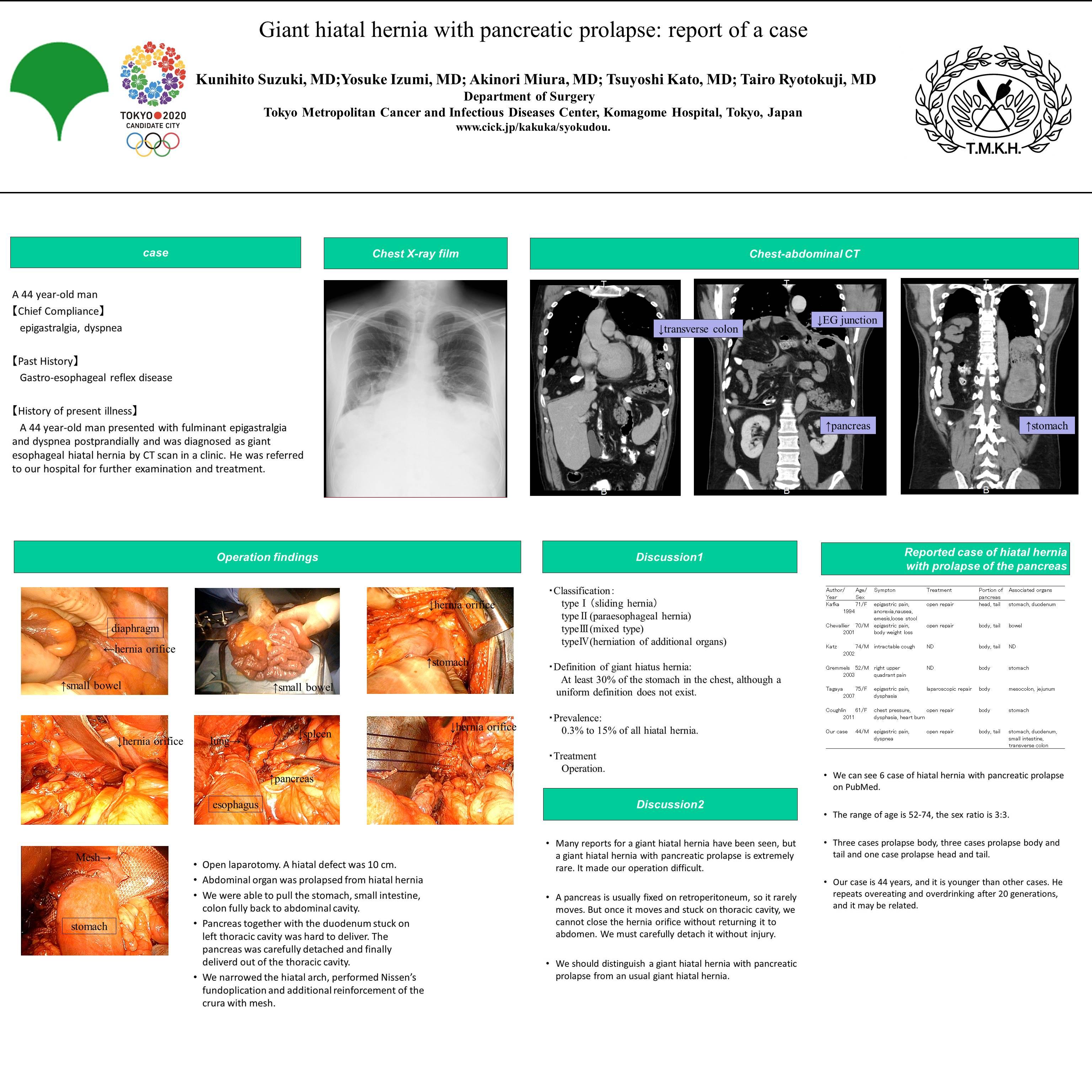
44 year-old man presented with fulminant epigastralgia and dypnea postprandially and was diagnosed as giant esophageal hiatal hernia by CT scan in a clinic. He was referred to our hospital for further examination and treatment. CT scan showed whole stomach, almost whole small intestine, right and transverse colon and pancreas prolapsed above diaphragm, and type IV esophageal hiatal hernia was diagnosed.We performed elective open hiatal hernia repair. Operative findings were a giant hiatal hernia, defined as a hiatal defect 10 cm, massive gastrointestinal prolapse and winding esophagus. We were able to pull the stomach, small intestine, colon fully back to abdominal cavity relatively easily, but pancreas together with the duodenum stuck on left thoracic cavity was hard to deliver. The pancreas was carefully detached and finally deliverd out of the thoracic cavity. We narrowed the hiatal arch, performed Nissen’s fundoplication and additional reinforcement of the crura with mesh. A giant hiatal hernia is a hernia that includes at least 30% of the stomach in the chest, although a uniform definition does not exist. Most commonly, a giant hiatal hernia is a type III hernia with a sliding and paraesophageal component. A giant hiatal hernia has a risk of volvulus and strangulation of the stomach though often undetected for years before this life-threatening event.
Many reports for a giant hiatal hernia have been seen, but a giant hiatal hernia with pancreatic prolapse is extremely rare and delivering pancreas was thought to be most difficult point during the operative procedure.


Session: Poster Presentation

Program Number: P241
Related


Hours & Info

15821 Ventura Blvd Ste 400
Encino, CA 91436

1-310-437-0544

[email protected]

Monday – Friday
8am to 5pm Pacific Time

Find Us Around the Web!

  • Bluesky
  • X
  • Instagram
  • Facebook
  • YouTube

Copyright © 2026 · SAGES · All Rights Reserved

Important Links

Healthy Sooner: Patient Information

SAGES Guidelines, Statements, & Standards of Practice

SAGES Manuals

Refine Search